
The image in Dhruvil Bavadiya’s work is in a constant state of forming. Fluid, like it were melting, he stays at the edge of certainty. A delicately swaying reflection, light breaking on the surface of water, and the night turning shadows into something more insistent than the fixed body – his work foregrounds a way of attending to the world before habit fixes it into stable categories. What is certain though is that they are not distant. Landscapes are foraged from photographs and the haze of memory. Its unstable edges are examined through silhouettes, reflections and transient illuminations and sites that resist immediate recognition.
Born in Ahmedabad in 2002 and based in Vadodara, Bavadiya studied at Sheth C.N. College of Fine Arts before completing a post-diploma in Visual Arts at the Faculty of Fine Arts, Maharaja Sayajirao University of Baroda. Working with painting and ceramics, his images inhabit the interlude within which the familiar becomes briefly unknowable.
The photograph and the mind are mediums to record a place or an incident in time, especially those that might seem insignificant. While a photograph is fixed, memory often fails and/or surprises us. Through a sincere, perceptive shift in medium, scale, and colour on surface-textures, the image is no longer evidence. It meets a mental recollection, hazy but somewhat perceptible and an image-atmosphere is formed.
In Sleeping Tree on the Choppy Water (2026), a lush arboreal structure rises to the center of a watery field, mirrored below, and framed by patches of pale blue. In its title, the act of sleeping evokes a vulnerability around restless waters. Rather than fixing the horizon, the work spills between the two planes where tree and shadow meet and diverge. His use of water recurs in At Dusk (2025), where small pools emerge from a dark, earthen field. They are illuminated by light and can be read as puddles, gaps, portals or sky-islands. Bavadiya uses these puddles to acknowledge that perception is episodic. We do not absorb and remember a place all at once; we assemble it from glimpses separated by time, movement and inattention. Water, then, becomes another medium of seeing and reflection - imperfect, yet true all the same.
Material transformation is fundamental to Bavadiya’s practice. In his paintings, oxide is combined with matte medium and acrylic on canvas or paper. In the ceramic works, underglaze enters the surface of stoneware and is altered by firing. Other works employ natural pigment on rice paper, where faint images seem barely held by the support. Each process commands its own duration. Rice paper absorbs delicately; oxide is mineral and alchemical and stoneware lends a voluminous density. Bavadiya’s fleeting images are held by these distinct surface conditions, none of which are neutral.
The small ceramic pieces make this tension especially palpable. Their irregular outlines preserve the handmade quality - images of railings, foliage and figures seem embedded in physical bodies whose rounded edges, warping and granular surfaces remain visible. Bavadiya lends transience to a body without attempting that the original instant can be recovered intact.
In No Signal (2025), a TV connection is lost. The screen flashes white noise. It looks like it is a little after dusk. Amidst steps, doors, vegetation and furniture split across the diptych another image is forming. There are two people in the frame, the woman and the person she is watching over. In the faint, fixed shadow, we see someone fixing the TV dish. The title evokes technological interruption, but also leaves us clues like signals. If we watch carefully, a narrative unfolds.
In a similar vein, Bavadiya’s Shadows Meeting the Feet (2026) cannot be seen in its entirety all at once - he upends what he understands as a convention of historical scroll painting. Rather than treating shadows and reflections as subordinate to depicted forms, he makes them the principal subject. The proposed sequence follows the shifting behaviour of light over the course of a day. Shadows stretch, contract, fade and return; each ceramic panel records a different atmospheric state. The work therefore does not illustrate time through clocks or narrative episodes. Time becomes visible indirectly, through alterations in shape, density and orientation.
The title stays close to the body. A shadow “meeting the feet” touches the point where the figure encounters the ground. It is evidence of presence, although it possesses no independent substance. By shifting attention from a person or object toward the shadow that accompanies it, Bavadiya complicates the distinction between subject and residue. What is usually secondary begins to direct the scene. This reversal has an ethical as well as optical force: seeing differently starts with attending to phenomena that established habits of looking teach us to dismiss.
Installation is essential to this encounter. The fourteen slabs in a gently curved scroll formation so that viewers can walk alongside them. The curve refuses a single frontal viewpoint. Looking becomes bodily and durational: the spectator approaches, travels, changes position and discovers that sections previously visible have slipped from view. Architectural lines, wall edges and shadow contours create a rhythm across the separate pieces, guiding the eye while never fully mitigating their divisions. The spaces between slabs operate as slippages or pauses within which the landscape finds quiet refuge before returning in another form, transformed.
While Bavadiya’s landscapes draw from what he sees and senses, these are neither entirely the outside world, nor the interior recesses of the heart and mind. They emerge where surroundings meet the unconscious rhythms of perception. The everyday becomes mysterious not because fantasy is imposed upon it, but because attention reveals how unstable, and fleeting the visible world already is. A reflection may belong to its source, yet it produces an entirely different reality. Fired earth may seem solid, permanent, yet it records an image of disappearance.
And ultimately, Bavadiya surrenders to chance. When fired, the surface and pigment changes – the works transform from when they leave Bavadiya’s precise care. The trace of an experience is registered by acknowledging its transformation.
Bavadiya asks us to remain within contradictions. We are asked to slow our impulse to identify, to let the image form or stabilise. Shadows stretch across surfaces, rainwater accumulates and we sense the day passing as it moves across walls and pathways.
Against this continual vanishing, the artwork does not claim to preserve experience unchanged. Instead, Bavadiya constructs forms through which change itself can be encountered. What endures is not the moment, but a heightened awareness of its passing - of the instant when a tree becomes its reflection, a wall becomes a site for moving light, and the familiar world quietly becomes strange..
Written By Mario D’Souza
Mario D’Souza is a curator and writer based between Goa, and Kochi, India. He is Director of Programmes at the Kochi Biennale Foundation and was on the curatorial team for the Kochi-Muziris Biennale (2025 and 2022). He is also a member and curator at HH Art Spaces, Goa.

Baroda-based contemporary artist Dhruvil Bavadiya (b.2002, Ahmedabad) works across ceramics and painting, documenting his observations from the natural landscape and surrounding infrastructure of his hometown. Using underglaze colours on stoneware clay, and oxides and paint on paper, he is drawn to the rustic quality of these materials and the way colour builds and layers across their surfaces differently. His works are fired locally in Baroda. Bavadiya completed his Diploma in Fine Arts at Sheth C.N. College of Fine Arts, Ahmedabad, and a Post-Diploma in Visual Arts from the Faculty of Fine Arts, Maharaja Sayajirao University in Baroda. He was the recipient of the 2026 Generator Grant by Experimenter. After Rain at Gallery Maxima is his debut solo exhibition.

Sleeping Tree on the Choppy Water
2026
96.7 × 90.4 cm
38.1 × 35.6 inches
Oxide with matt medium and acrylic on paper
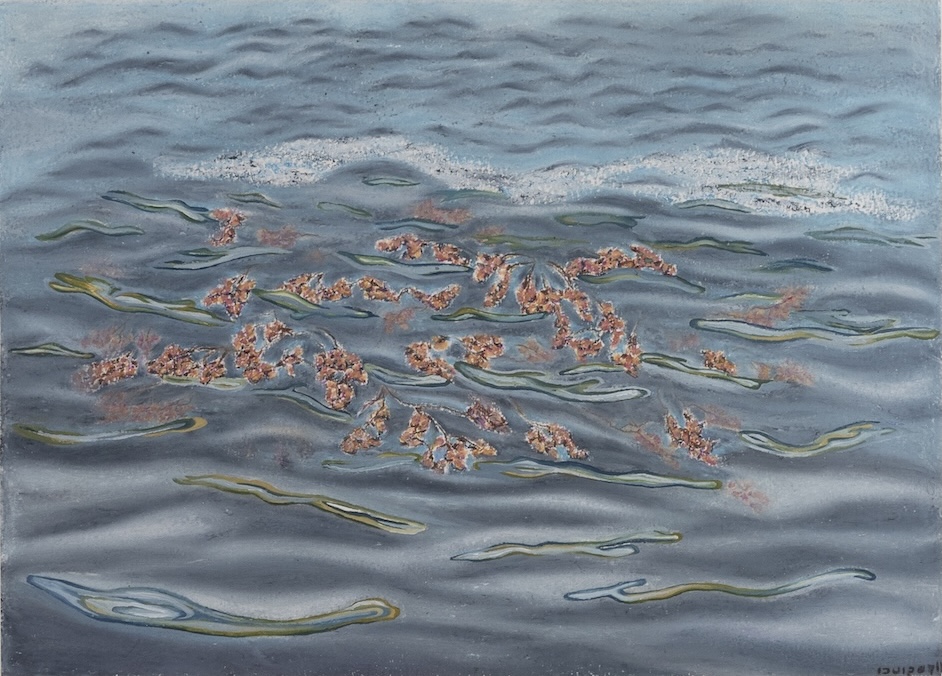
Floating
2026
42 × 32.5 cm
16.5 × 12.8 inches
Oil pastel on paper
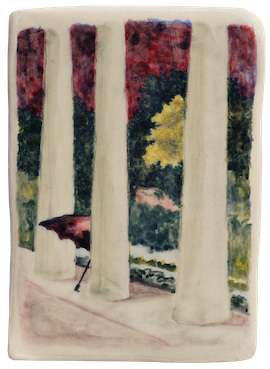
On the Porch
2025
20.3 × 14 cm
8 × 5.5 inches
Underglaze painting on stoneware clay
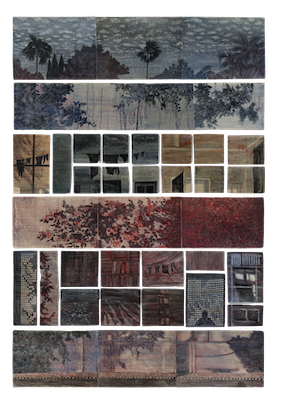
Monsoon Silhouettes
2026
91.4 × 122 cm
36 × 48 inches
Underglaze painting on stoneware clay
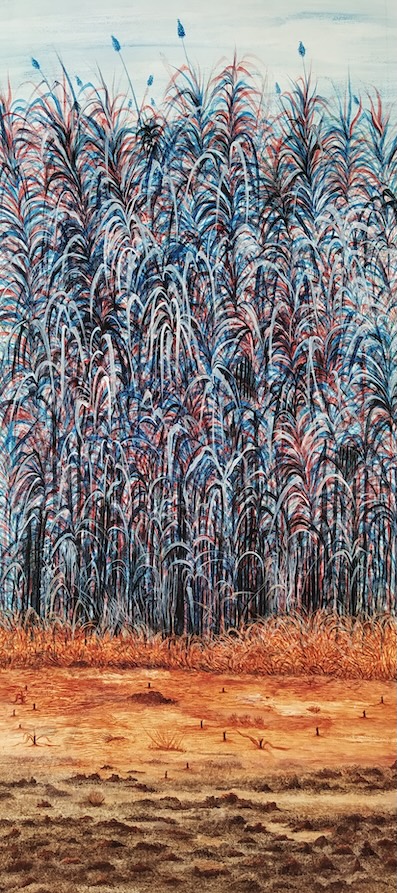
Sorghum
2024
72.3 × 33 cm
28.5 × 13 inches
Oxide pigments with acrylic on canvas

Sakura
2025
41 × 17 cm
16 × 6.6 inches
Underglaze painting on stoneware clay

Glimmers on the Lake
2026
110 × 80 cm
43.3 × 31.5 inches
Oxide with matt medium and acrylic on paper

Going to canteen
2023
19 × 30.4 cm
7.5 × 12 inches
Oxide pigments with acrylic on canvas

Shadows Meeting the Feet
2026
290.8 × 45.7 cm
114.5 × 18 inches
Underglaze painting on stoneware clay

Forest of Campus
2023
68.5 × 50.8 cm
27 × 20 inches
Oxide pigments with acrylic on canvas
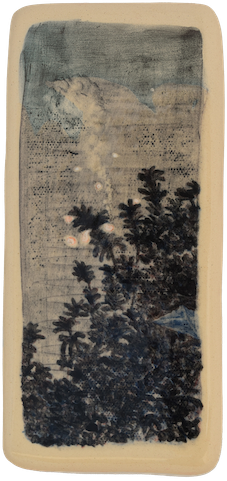
Evening Sky
2025
15.2 × 7.6 cm
6 × 3 inches
Underglaze painting on stoneware clay

Outdoor practice
2023
340.8 × 45 cm
134.2 × 17.7 inches
Oxide pigments with acrylic on canvas
Tuesday to Saturday, 10.30 AM – 6.30 PM
Sundays & Mondays closed
